
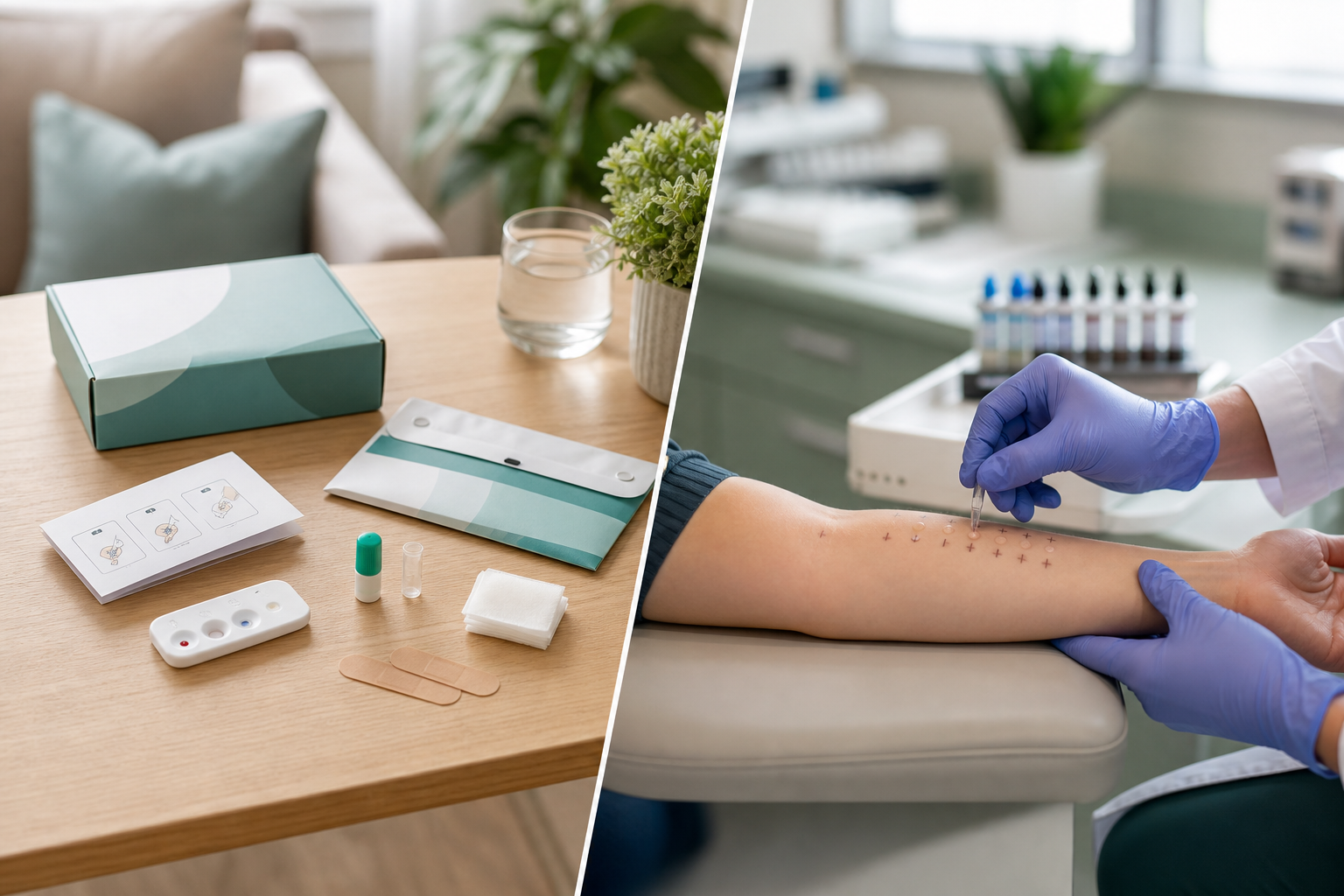
Why so many people are trying an at-home allergy test first
You see the ad on Instagram. Prick your finger, mail a sample, get a list of triggers. No waiting room. No referral. For a lot of Plano families juggling work, school, and cedar season, an at-home allergy test feels like the obvious first step.
That convenience is real. So is the confusion that follows when one kit says you are “highly reactive” to dust mites and another barely mentions them. Home testing has gotten better, but it is not the same thing as testing ordered and interpreted by a clinician who knows your symptoms, your meds, and your history.
This article compares at-home kits with in-office allergy testing in plain terms: what each method measures, how reliable the results tend to be, and when each option actually makes sense. The goal is not to scare you away from home kits. It is to help you use them wisely and know when you need a visit.
What an at-home allergy test actually measures
Most consumer allergy kits you order online test blood for allergen-specific IgE antibodies. IgE is an immune protein your body can produce when it treats a substance as a threat. Higher levels can suggest sensitization, meaning your immune system has flagged that allergen before.
Important distinction: sensitization is not the same as a clinical allergy. You can have IgE to a food or pollen and never have symptoms. You can also have miserable spring congestion with test results that look borderline. Numbers alone do not tell the whole story.
Home kits vary in which panels they run. Some cover dozens of foods and environmental triggers. Others focus on inhalants like tree pollen, grass, mold, and dust. Read the panel list before you buy. A kit that skips Texas cedar pollen is not useless, but it may miss what actually bothers you in Collin County from December through February.
Collection is usually a finger stick or a small blood spot card you mail to a lab. Turnaround is often a week or two. Results typically arrive as a dashboard or PDF ranking triggers as low, moderate, or high.
For a deeper look at kit quality and marketing claims, see are at-home allergy test kits reliable. That piece walks through what is solid science and what is still mostly hype.
What happens during in-office allergy testing
In a clinic, allergy testing usually starts with a conversation. Your clinician asks when symptoms show up, whether antihistamines help, if you have asthma or eczema, and what you have already tried. That history shapes which tests are appropriate.
The two most common in-office approaches are skin testing and blood IgE testing ordered through a lab. Skin prick testing places tiny amounts of allergen extract on your skin and watches for a localized hive. Results are read in about 15 to 20 minutes. Blood testing, similar to home kits in what it measures, is often used when skin testing is not safe or practical, such as when you are on medications that interfere with skin results or when you have a skin condition that covers large areas.
Skin testing generally reflects what your body is reacting to right now in a controlled setting. It is widely used because it is fast, sensitive for many environmental allergies, and easy to interpret in context. Blood IgE testing can cover a broad panel without exposing you to allergens directly.
Neither method is perfect on its own. That is why clinicians sometimes use both, plus a trial of treatment, to see what actually changes how you feel. FAQs about allergy testing covers common patient questions about prep, medications to pause, and what positive results mean in daily life.
Accuracy: where home kits do well and where they fall short
Lab technology behind many home kits is legitimate. Certified labs can measure IgE with solid precision. The weak link is often not the blood draw. It is what happens before and after the sample.
Home kits rarely review your medications, recent illness, or symptom patterns before results are generated. They also cannot examine your nose, lungs, or skin for clues that point away from allergy altogether. Chronic sinus issues, non-allergic rhinitis, reflux, and migraine-linked congestion can all mimic allergies. A kit will still list pollen scores even when pollen is not your main problem.
In-office testing adds clinical judgment. A positive skin test to grass pollen matters more when you cough every April and feel better on antihistamines. A positive food IgE on a home panel matters less if you have eaten that food without symptoms for years.
Research summaries from bodies like the American Academy of Allergy, Asthma and Immunology emphasize matching test results to clinical history. Testing without context leads to unnecessary avoidance diets, expensive air purifiers, and anxiety about foods that were never dangerous for you.
If you want detail on misleading positives and negatives, read how accurate allergy tests are. False results are common enough that they should be part of any testing decision, not an afterthought.
At-home vs. in-office: a practical comparison
Neither option wins every category. Here is how they usually stack up for adults with typical seasonal or environmental symptoms.
- Convenience: Home kits win. You test on your schedule without driving to an appointment.
- Speed of initial results: Skin testing in clinic often gives same-day answers. Home kits depend on shipping and lab queues.
- Symptom context: In-office testing wins. A clinician connects results to your exam and history.
- Panel breadth: Many home kits advertise large food and environmental panels. Clinics tailor panels so you are not paying for irrelevant triggers.
- Medication interference: Antihistamines can affect skin tests. Clinicians tell you what to stop and for how long. Home IgE blood tests are less affected, but interpretation still matters.
- Follow-up and treatment: In-office care can move directly into immunotherapy discussion, prescriptions, and action plans. Home kits generally stop at a PDF.
- Cost predictability: Both vary. Kits have upfront pricing. Clinic costs depend on insurance and which tests are ordered. Neither is automatically cheaper.
Reliability is less about “lab vs. no lab” and more about whether the right test was chosen for the right question. That is where in-office care still has a clear edge for most patients who want answers they can act on.
When a home kit might be enough
There are situations where starting at home is reasonable, especially if you treat the results as a screening tool rather than a final diagnosis.
You might use a home blood panel if you have mild, stable symptoms, you cannot get an appointment for several weeks during peak pollen season, and you want a rough sense of whether dust, pets, or grasses show up on testing. Some people also use home testing when they live far from an allergist and want data to bring to a primary care visit later.
Home kits can be a conversation starter. Bring the printout to your clinician and ask which positives fit your real-life pattern. That follow-up step is not optional if you plan to change diet, buy expensive mattress covers, or consider shots.
Even in these cases, choose kits processed by certified labs with clear panel lists. Avoid products that promise to diagnose dozens of conditions from one drop of blood. Allergy testing is narrow by design. Allergy testing: a comprehensive guide explains how medical testing fits into a longer management plan, not a one-time shopping decision.
When to skip the mail-in kit and book in-office testing
Some red flags mean you should not rely on a home kit alone.
- Breathing trouble, wheezing, or chest tightness with exposure to triggers
- Food reactions involving swelling, vomiting, hives over a large area, or feeling faint
- Symptoms that do not match seasons or that persist despite standard meds
- Positive home results you are unsure how to interpret, especially for foods you eat regularly
- Need for immunotherapy (allergy shots or drops), which requires documented testing and monitoring
- Skin rashes that might be contact dermatitis rather than IgE-mediated allergy. Metal, fragrance, and personal care products can mimic allergy patterns. See digital-age allergies and contact reactions for how everyday objects trigger skin flares without showing up on a pollen panel.
Children with unclear symptoms also deserve in-person evaluation. Kids grow fast, allergy patterns shift, and avoidance advice that is too strict can affect nutrition and school life.
If you already take daily antihistamines and feel only partly better, testing plus an exam often reveals overlap problems: poorly controlled allergies, sinus inflammation, or irritant triggers home kits never measure.
False positives, false negatives, and why context beats a score
A “high” IgE result can show up when your immune system has met an allergen but your daily life is unaffected. That is a false positive in practical terms even if the lab number is accurate. Conversely, you can have significant seasonal symptoms while blood or skin tests look only mildly positive, especially if you tested outside your usual flare window or while taking suppressive meds.
Food panels on home kits are a frequent source of overreaction. Patients cut out foods for months based on numbers, not reactions. Unless you have had consistent symptoms with a specific food, a positive IgE alone rarely justifies strict elimination.
Environmental panels have similar traps. Mold IgE can be positive in many healthy adults. The question is whether mold exposure explains your cough and fatigue, or whether you need a home inspection, different meds, or another diagnosis entirely.
Clinicians interpret tests using something called clinical correlation, which sounds formal but means “does this match what you actually experience?” That step is where in-office care earns its keep. It is also the piece home kits cannot replicate with an app.
Allergy testing in Plano and Collin County
North Texas pollen is not subtle. Cedar, oak, ragweed, and grass cycles hit different months, and many residents feel like they have year-round congestion even when the counts rotate. Testing during the wrong month can underplay a trigger that derails you in six weeks.
If you are considering a home kit in late summer, remember fall weeds start soon. If you test in winter, cedar may dominate before your results arrive. Timing will not ruin every test, but it can skew how closely numbers match what you feel.
Plano and surrounding suburbs also have plenty of indoor triggers: dust mites in climate-controlled homes, pet dander, and mold after leaks or heavy rains. A good testing plan covers both indoor and outdoor panels when symptoms are perennial.
Primary care can order initial testing, interpret results, and start first-line treatment. Referral to an allergist makes sense when shots are on the table, food allergy is suspected, or symptoms stay uncontrolled after a careful med trial. You do not have to choose between “only home” and “only specialist.” Many patients use clinic testing once, then manage seasonally for years with a familiar team.
What to do with your results either way
Whether your results come from a kit or a clinic, treat them as a map, not a sentence.
Start with triggers that match your symptom calendar. If you only feel sick in March and grass is high on your report, that alignment matters. If shrimp lights up on a panel but you eat pad thai every Friday without issue, do not overhaul your diet without medical guidance.
Next steps often include environmental controls (HEPA filters, pillow covers, pet boundaries), consistent meds rather than only on bad days, and follow-up testing if treatment fails. Immunotherapy is a longer conversation that requires documented allergy and realistic time commitment.
Bring home kit results to a visit even if you feel embarrassed about going the DIY route first. Clinicians would rather interpret existing labs than repeat them unnecessarily. If the kit used a reputable lab, some values can be incorporated into your chart.
Finally, retest only when something meaningful changes: new symptoms, new exposures, or treatment that should have worked but did not. Allergy patterns evolve, but chasing monthly kits usually creates more noise than insight.
Common questions about at-home and in-office allergy testing
Are at-home allergy tests as accurate as in-office testing?
They can use similar lab methods to measure allergen-specific IgE, so the raw numbers are not automatically unreliable. Accuracy in the medical sense also depends on choosing the right panel, testing at a meaningful time, and interpreting results against your symptoms. In-office testing adds exam, history, and often skin testing, which together reduce false conclusions. Home kits are better viewed as screening tools than complete diagnostic workups.
If your kit results surprise you, or do not match what you feel day to day, bring them to a clinician rather than assuming the kit or your instincts alone are wrong.
Can I take antihistamines before an at-home blood allergy test?
Most blood IgE tests, including many home kits, are less affected by antihistamines than skin prick testing. You should still follow the kit instructions exactly and tell your clinician which meds you take regularly. Sedating and non-sedating antihistamines, nasal steroids, and some other drugs can influence symptoms even when blood levels look unchanged.
If you are planning clinic skin testing later, save the kit instructions and med list so your care team can coordinate timing without repeating labs unnecessarily.
How long do at-home allergy test results take?
Most mail-in kits take about one to two weeks after your sample arrives at the lab, though busy seasons and shipping delays can stretch that timeline. Clinic blood draws sent to outside labs follow a similar window. Skin prick testing in the office usually gives results the same day because reactions are read on site within minutes.
Plan ahead if you are testing because of a known season. Waiting until peak cedar week to start a kit may mean you suffer through half the season before results land.
Do positive food results on a home kit mean I have a food allergy?
Not necessarily. A positive IgE to a food means your immune system has been sensitized, which is only one part of a true food allergy diagnosis. Many people have positive IgE levels to foods they tolerate without symptoms. Dangerous food allergy also involves a pattern of reactions with exposure, not just a lab number on a dashboard.
Do not start strict elimination diets based on home panels alone, especially for children, without guidance. Unnecessary restriction can affect nutrition and quality of life.
When should I book in-office allergy testing in Plano?
Book an in-person visit if you have breathing symptoms, suspected food allergy with systemic reactions, symptoms that persist despite meds, or home results you do not understand. In-office testing is also the right path if you are considering allergy shots or need documentation for school, work, or travel accommodations.
Primary care offices in Plano and Collin County can often start the workup locally and coordinate referral when specialist care is appropriate, so you are not stuck navigating the process alone after a confusing kit report.